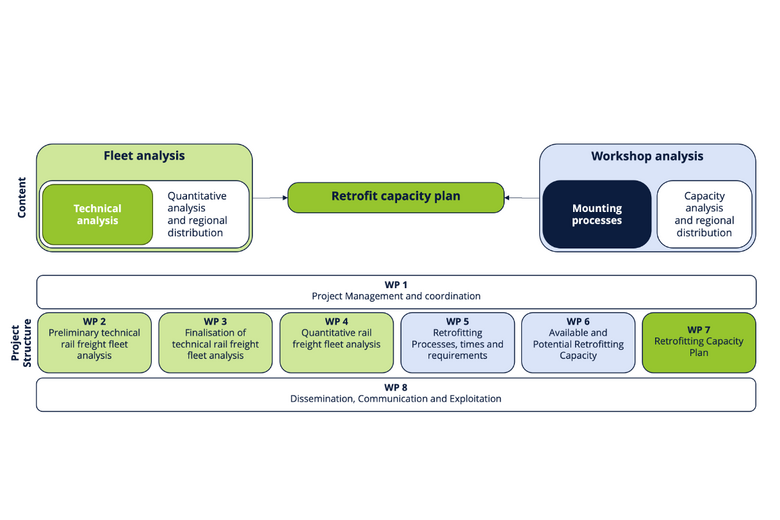
Work package WP1 – Project Management and coordination
WP1 is dedicated to achieving the overall success of the project. This involves a set of specific objectives: Firstly, WP1 aims to execute project activities according to the planned timeline, allocated budget, and the predefined quality standards. Secondly, it involves the efficient compilation and provision of the necessary reports to the EU-Rail services. Furthermore, WP1 is responsible for guiding and closely monitoring the progress of the project to ensure that all deliverables are submitted within their respective deadlines. Additionally, WP1 plays a crucial role as an interface between the project and external stakeholders, facilitating effective communication and collaboration with the EC and other relevant parties.
Work package WP2 – Preliminary technical rail freight fleet analysis
The primary goal of Work Package 2 (WP2) is to conduct a thorough technical evaluation of the key types of vehicles (different locomotive types, wagon types, DAC components and their combinations) in terms of technical state and their suitability for upgrades or retrofitting. This assessment will be carried out during the first year of the project, from month 1 to month 12. The focus will be on categorizing the various vehicle types based on how well they can be adapted to newer technologies and systems as part of the project's objectives. The retrofitting plan will not consider alternative solutions (e.g. digital and electrical connection in freight wagons via axle generators without automatic couplers for block trains). Furthermore, there is no list of freight wagons exempted from retrofitting. The Project approach is not to exclude certain wagons from being upgraded but to differentiate between varying levels of complexity and effort required for the retrofitting process. This strategy is aimed at maintaining a high availability of wagons in rail freight transport. By managing the retrofitting efforts in this manner, it is ensured that the wagons remain operational and continue to support the efficient functioning of the rail freight sector.
Work package WP3 – Finalisation of technical rail freight fleet analysis
The primary objective of WP3 is to enrich and conclude the analyses initiated in WP2. WP3 may expand upon the range of vehicle types under consideration, incorporate new data, and thoroughly document the outcomes. This package will ensure that the retrofitting analysis is comprehensive, up-to-date, and well-defined for practical application.
Work package WP4 – Quantitative rail freight fleet analysis
Main objective of WP4 is to develop an as much as possible detailed inventory analysis and overview of the rail freight vehicle fleet utilizing the standard 1435mm track gauge across Europe. This inventory will include a count and classification of locomotives and wagons, differentiated by specific vehicle types. Additionally, the analysis will identify the distribution and operational regions of these vehicles within Europe, detailing the number of vehicles by type that are active in each region.
Work package WP5 – Retrofitting Processes, times and requirements
WP5 is designed to establish a clear and efficient framework for retrofitting rail freight vehicles across Europe. The main goal is to detail the retrofitting processes, estimate the time and effort required, and outline additional requirements such as staff qualifications and workshop equipment needs.
Work package WP6 – Available and Potential Retrofitting Capacity
The core objective of WP6 is to determine a network of workshops along with their retrofitting capacities and staffing availability, which are equipped to carry out the Digital Automatic Coupling (DAC) retrofitting activities. WP’s aim is to identify and, where necessary and feasible, enhance the retrofitting capacities of European rail freight workshops. This will specifically address their ability to implement Digital Automatic Coupling (DAC) retrofitting for a range of rail freight vehicles.
Work package WP7 – Retrofitting Capacity Plan
WP7 is aimed at formulating a comprehensive strategic retrofitting plan that addresses the operational, technical, and scheduling aspects tailored for traffic types and the associated fleet. Objective is to gather all required information and experts insights generated in WP2, WP3, WP4, WP5 and WP6 over the course of the project. WP7 is dedicated to crafting a strategic plan that incorporates both quantitative and qualitative elements, such as geographic allocation and temporal distribution of demand and capacity, into a comprehensive gap analysis. This analysis will highlight bottlenecks within the retrofitting process and propose effective countermeasures to overcome them. Additionally, as a foundational measure, WP7 intends to set-up and use a Decision Support System (DSS). This system will facilitate informed decisionmaking by consolidating relevant data, providing insights and recommendations to support the intricate process of retrofitting across different fleet segments and traffic types.
Work package WP8 – Dissemination, Communication and Exploitation
The main objective of WP 8 is to implement the project’s dissemination and communication activities to maximize visibility of the DACFIT outcomes and results, thus attracting more active contributors for DAC migration activities.